

CASE STUDIES
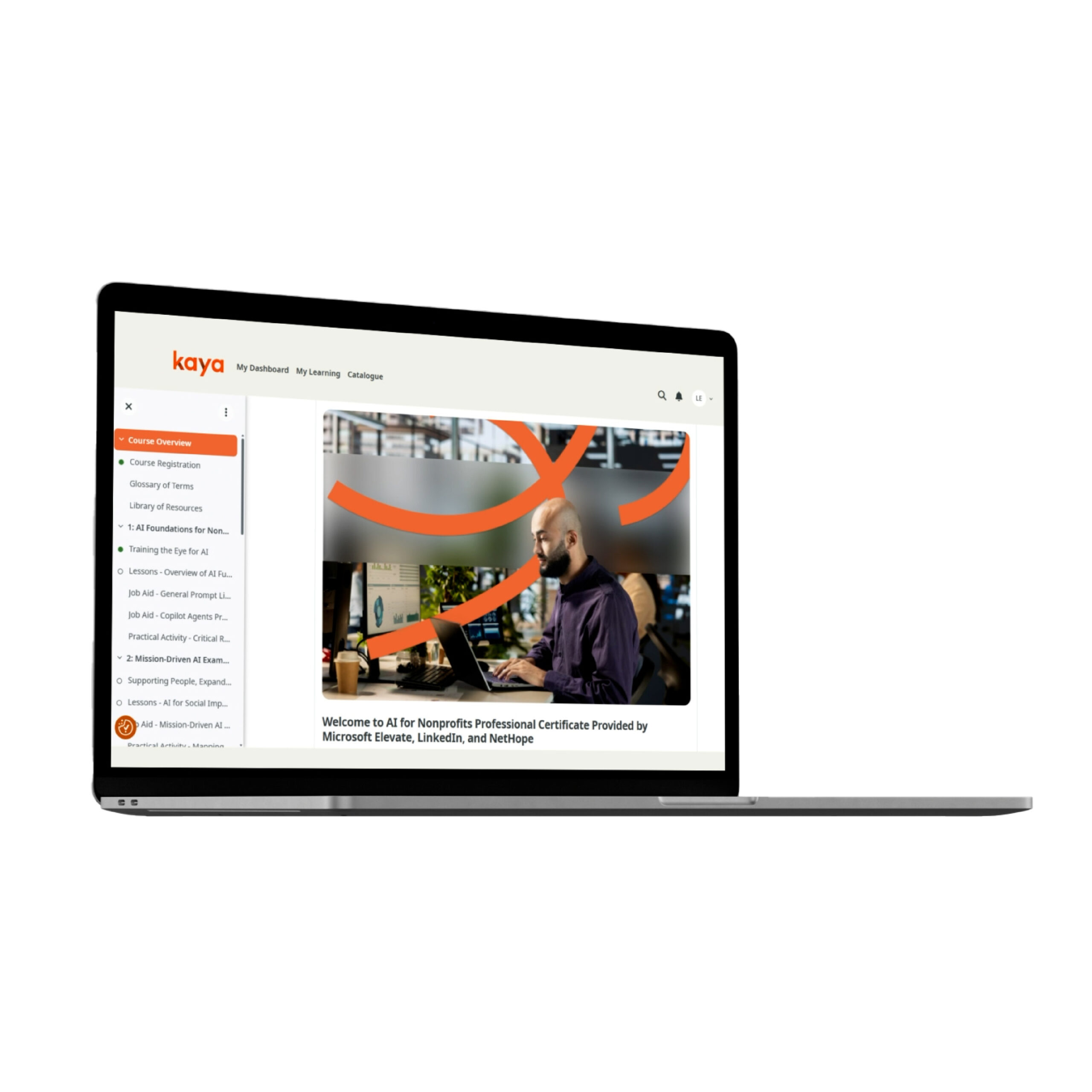
Design Once, Deliver Many Ways Building a Global AI Learning Ecosystem with NetHope
NetHope is a consortium of over 60 leading global nonprofits, that unites with technology companies and funding partners to design, fund, implement, adapt, and scale innovative approaches to solve development, humanitarian, and conservation challenges. As artificial intelligence began reshaping how organizations work, NetHope saw both an opportunity and a risk for the sector it serves: AI tools could help nonprofits do more with limited resources, but only if the people using them understood how to apply AI responsibly, confidently, and in line with humanitarian values.
To address this, NetHope partnered with Microsoft Elevate and LinkedIn to launch the AI for Nonprofits Professional Certificate, a practical, values-driven program designed to build AI literacy across civil society organizations worldwide. The goal was not simply to teach people how to use new tools. It was to prepare a diverse, global workforce to adopt AI in a way that increase impact, improve operational efficiency, and strengthen services while remaining grounded in humanitarian values and ethical responsibility.
SERVICES USED:
Learning Experience Design (LXD), Learning Production, LMS Implementation, Localization & Translation.
INDUSTRY:
Nonprofit / Humanitarian / International Development.
KEY INFORMATION_
Bridging the AI Readiness Gap_
The nonprofit sector is not a single audience. It is thousands of organizations operating in different countries, working in different languages, and sitting at very different points on the AI readiness curve. Some teams had already experimented with AI tools; many had not. Levels of technical capacity, digital infrastructure, and access to learning systems varied widely from one organization to the next.
That diversity created a design problem that a conventional course could not solve. A single, fixed program (built in one language, hosted on one platform, written for one type of learner) would have excluded large parts of the sector or forced a costly redesign every time a new organization wanted to use it. NetHope needed something that could support different delivery models, enable localization, and stay relevant across a wide range of contexts while still producing consistent learning outcomes.
The stakes went beyond convenience. Nonprofits often work with vulnerable populations, which means questions of data privacy, bias, and responsible use are not abstract concerns. Many professionals also approached AI with limited experience and low confidence, and most had little access to practical, role-specific examples showing how AI applied to their actual work. Combined with the resource constraints common across the sector, these realities pointed to a clear conclusion: the answer was not a course. It was a learning ecosystem capable of supporting responsible AI adoption at scale.

Designing a Learning Ecosystem That Scales_
The central decision shaped everything that followed. Rather than building one learning product, we designed a flexible ecosystem around a shared instructional architecture. The same learning objectives, content foundation, and assessment standards would sit at the center and could then be delivered through multiple channels and adapted by individual organizations without losing alignment.
That architecture made three complementary pathways possible.
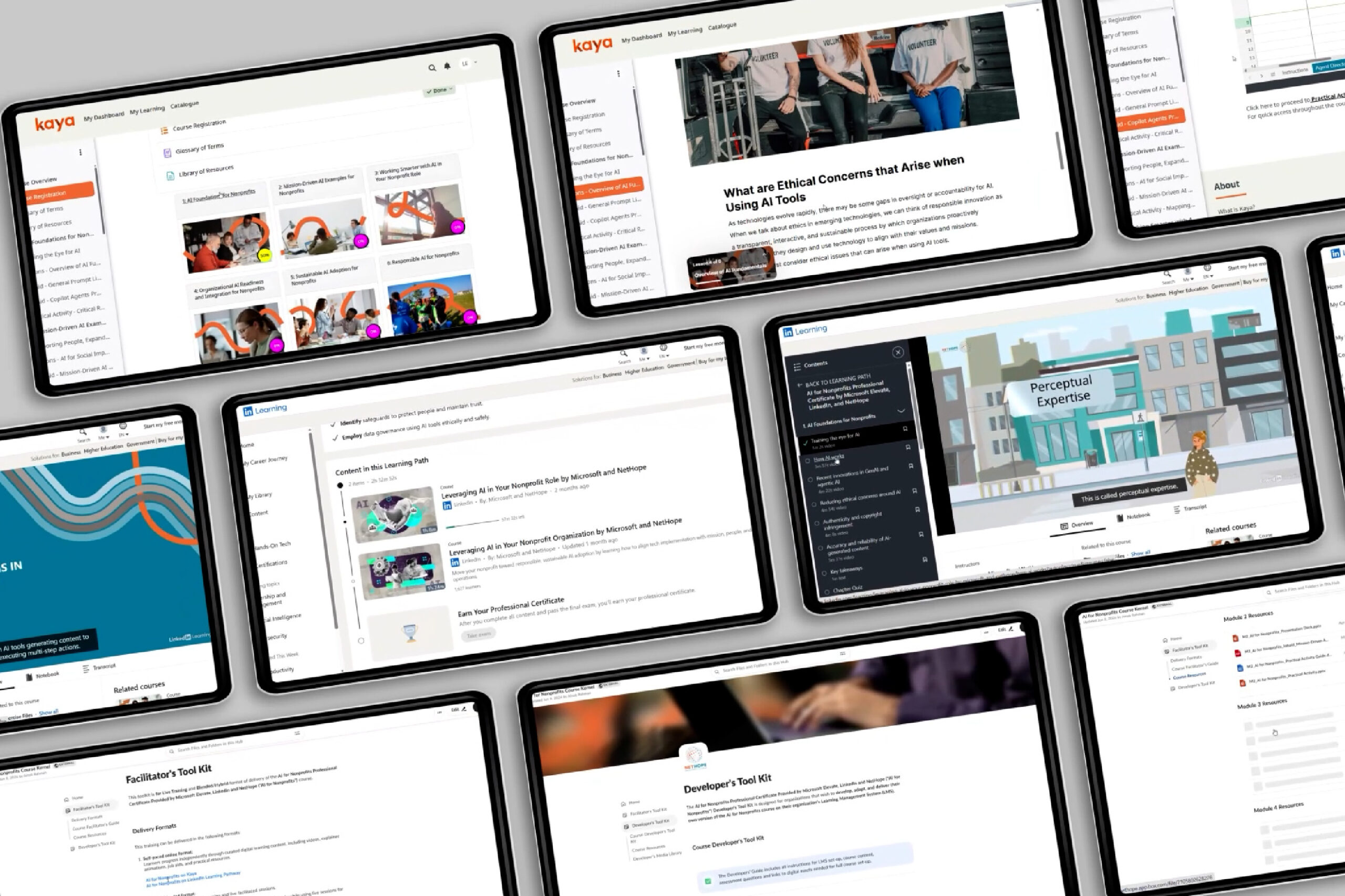
Self-paced learning on Kaya Connect gave individuals a way to work through interactive content, practical resources, and assessments on their own schedule, independent of any single organization’s training calendar.
A LinkedIn Learning pathway extended the same architecture into a platform people already use for professional development, widening access and supporting recognized credentialing.
An organization enablement package addressed the needs of organizations that wanted to run the program themselves. Combining a Developer’s Kernel and a Facilitator Toolkit, it included implementation guidance, trainer guides, presentation decks, practical activities, assessments, certificates, digital assets, and supporting resources. With these, an organization could customize content, localize examples, select the modules most relevant to its teams, host the experience on its own LMS, and deliver instructor-led or blended programs, all while staying aligned to the core curriculum and learning objectives.
Accessibility and localization were built in from the start rather than added later. The experience was developed for delivery in English, French, Spanish, German, and Brazilian Portuguese, and the role-relevant framing meant a fundraiser, a program officer, and an operations lead could each see how AI connected to their own responsibilities. Throughout, responsible AI principles were woven into the content rather than treated as a separate compliance module. Delivered in close collaboration with NetHope, Microsoft Elevate, and LinkedIn, the design balanced a consistent global standard with the flexibility local organizations needed.
Outcomes That Matter_
The most important outcome was structural: NetHope ended up with a scalable learning ecosystem rather than a standalone course. From a single instructional architecture, the initiative can now support self-paced learning, professional credentialing, instructor-led delivery, blended programs, organization-hosted LMS implementations, and multi-language adaptations.
That flexibility changes what is possible across the network. Organizations are no longer choosing between a generic program and an expensive custom build. They can take a proven foundation and shape it to their teams, their language, and their context, without commissioning a full redesign each time. Because every pathway traces back to the same curriculum, learning objectives, and responsible AI principles, the sector gains consistency and local relevance at the same time, which is rarely an easy combination to achieve.
For a consortium whose strength lies in its breadth, that matters. A shared foundation that travels well across audiences, platforms, and languages gives member organizations a common starting point for building AI capacity while leaving room for each to adapt it to the communities they serve.
Conclusion_
The AI for Nonprofits initiative shows what becomes possible when learning is designed as an ecosystem rather than a single deliverable. Designing for multiple approaches from the outset is not about producing more courses; it is about creating a foundation that can scale across audiences, platforms, languages, and contexts as needs evolve.
For the civil society sector, that approach offers a sustainable path to AI capacity, one that can grow alongside the technology itself and continue supporting responsible, values-driven adoption long after the first cohort of learners has finished. For organizations weighing how to prepare their people for AI, the lesson is a practical one: the way you architect the learning determines how far, and how responsibly, it can travel.
